
Engineered Automatic Fire Sprinkler Systems in Jammu & Kashmir
Design, hydraulic calculation, grid distribution piping, alarm check valve stations, and NBC 2016 Part 4 compliance commissioning for commercial complexes, warehouses, hotels, and industrial plants across J&K.
[B]BASELINE: PRESSURIZED WET-PIPE GRID
The Unforgiving Speed of Overhead Fire Propagation in Multi-Occupancy Buildings
A localized fire doubles in heat output every 60 seconds. In high-density commercial spaces, multi-floor hotels, and high-rack storage warehouses, manual firefighting teams cannot reach the seat of the fire fast enough to stop flashover.
Vertical & Horizontal Thermal Propagation
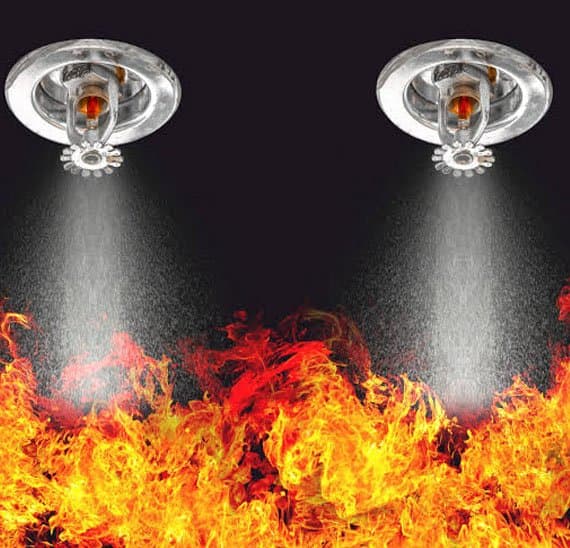
Combustible packaging, hotel furnishings, and high-bay storage racks act as vertical thermal chimneys. Automatic sprinkler heads actuate independently right above the heat source before flames spread laterally.
Flashover and Structural Collapse Danger
Uncontrolled structural temperatures exceeding 500°C cause steel trusses to buckle. Sprinklers suppress thermal radiation and cool upper smoke layers to maintain building integrity.
Mandatory Statutory Fire NOC Compliance
Under NBC 2016 Part 4 Table 7, commercial occupancies exceeding 15 meters in height, hotels with over 20 rooms, and basements over 200 sq m are legally required to maintain a fully pressurized automatic sprinkler grid.
Facilities Requiring Automatic Fire Sprinklers in J&K
Tailored sprinkler hydraulic density engineering for commercial, hospitality, industrial, and storage facilities across J&K.
Hotels, Pilgrim Resorts & Multi-Story Commercial
Katra (Vaishno Devi Corridor), Jammu City, Srinagar- Multi-floor guest room fire spread
- Basement car parking smoke loads
- Vertical atrium flame spread
High-Bay Warehouses & Logistics Distribution Centers
Bari Brahmana Logistics Hubs, NH44 Jammu-Pathankot Highway- Dense high-rack pallet storage up to 12 meters
- Combustible cardboard packaging
- High fire load density
Hospitals & Multi-Wing Healthcare Centers
Jammu Urban, Srinagar Medical Corridor, AIIMS Vijaypur- Non-ambulatory ward occupants
- High-density oxygen therapy zones
- Critical diagnostic corridors
Industrial Manufacturing & Assembly Sheds
SIDCO Industrial Estates, Samba IGC, Kathua & Ghatti- Manufacturing assembly lines
- Raw material storage bays
- Overhead electrical bus ducts
Turnkey Automatic Sprinkler Engineering & Hardware Scope
BSS Fire delivers complete hydraulic grid sizing, alarm valve installation, grooved mechanical piping fabrication, and certified flow testing.
NBC 2016 Part 4 head-loss & loop pressure calculations.
Heavy Class C ERW/Seamless MS welding by certified pipefitters.
15 kg/cm² 24-hour pressure hold test with calibrated gauges.
J&K Fire Services Single Window clearance dossier handover.
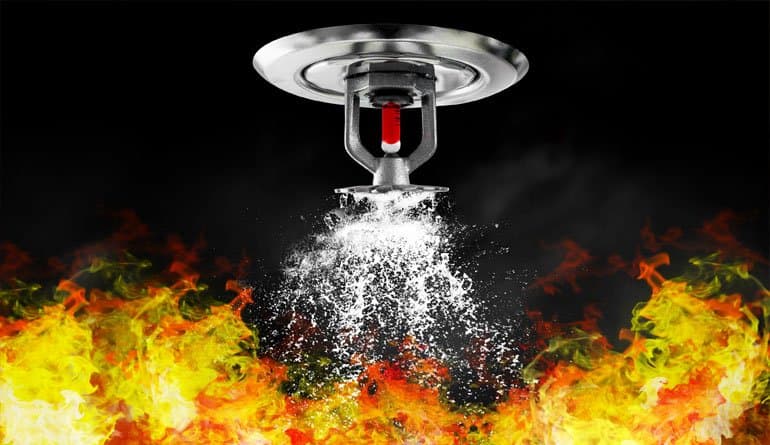
UL-Listed & FM-Approved Automatic Sprinkler Heads
High-sensitivity thermally actuated glass bulb heads (Pendent, Upright, Sidewall, Concealed, and ESFR) rated at 57°C (orange), 68°C (red), 79°C (yellow), or 93°C (green) with calibrated K-factors from K-5.6 to K-25.2.
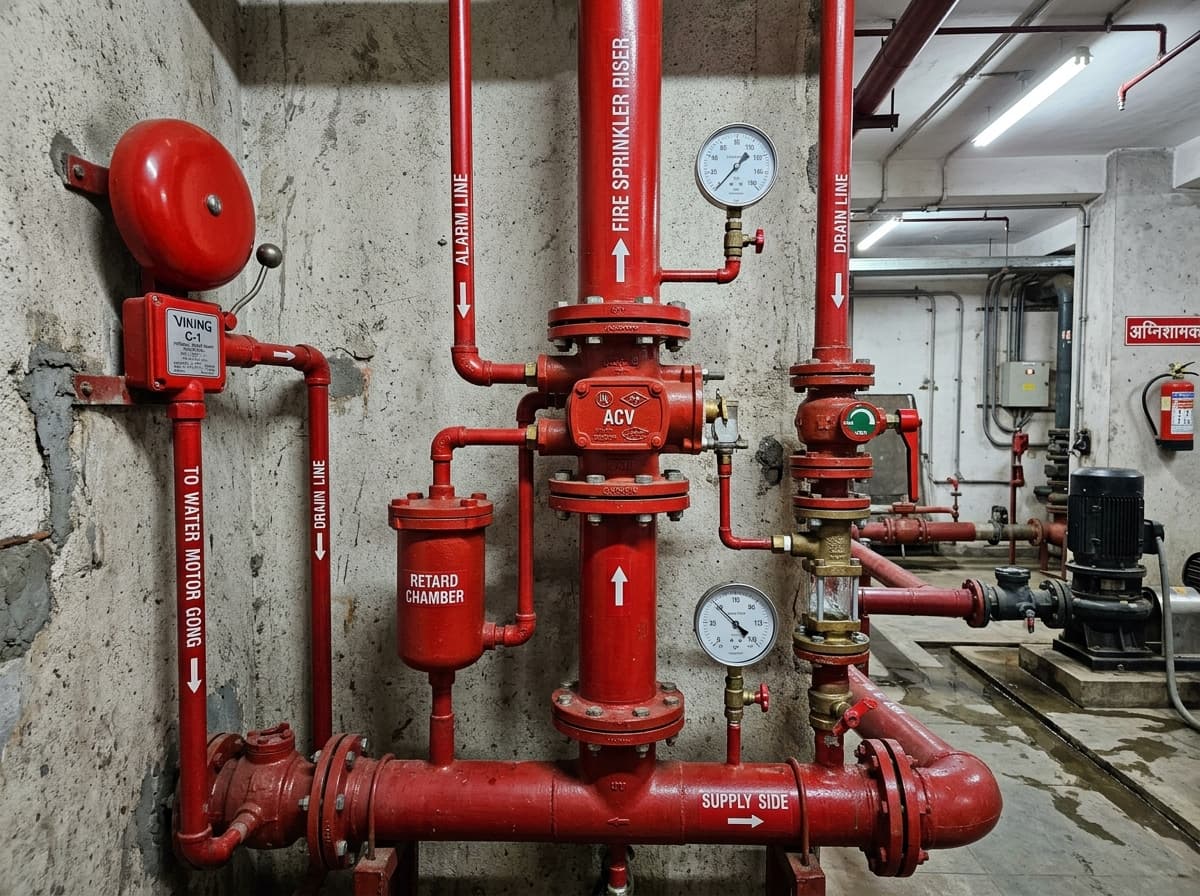
Alarm Valve Station & Hydraulic Water Motor Gong
Heavy-duty cast iron Alarm Check Valves (ACV) equipped with retard chambers to absorb municipal pressure surges, mechanical water motor gongs that sound audible alarms without electricity, and pressure gauges.
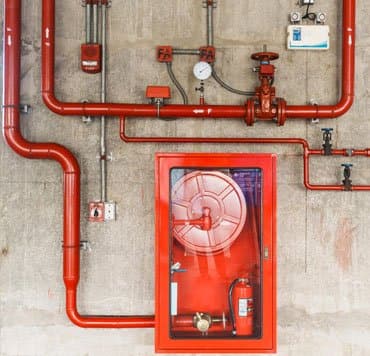
Zoned Water Flow Switches & Tamper-Monitored Butterfly Valves
Vane-type water flow detectors installed on every building floor riser with 0-60 second adjustable retard timers, sending instantaneous floor-level water flow alarms to the central FACP panel.
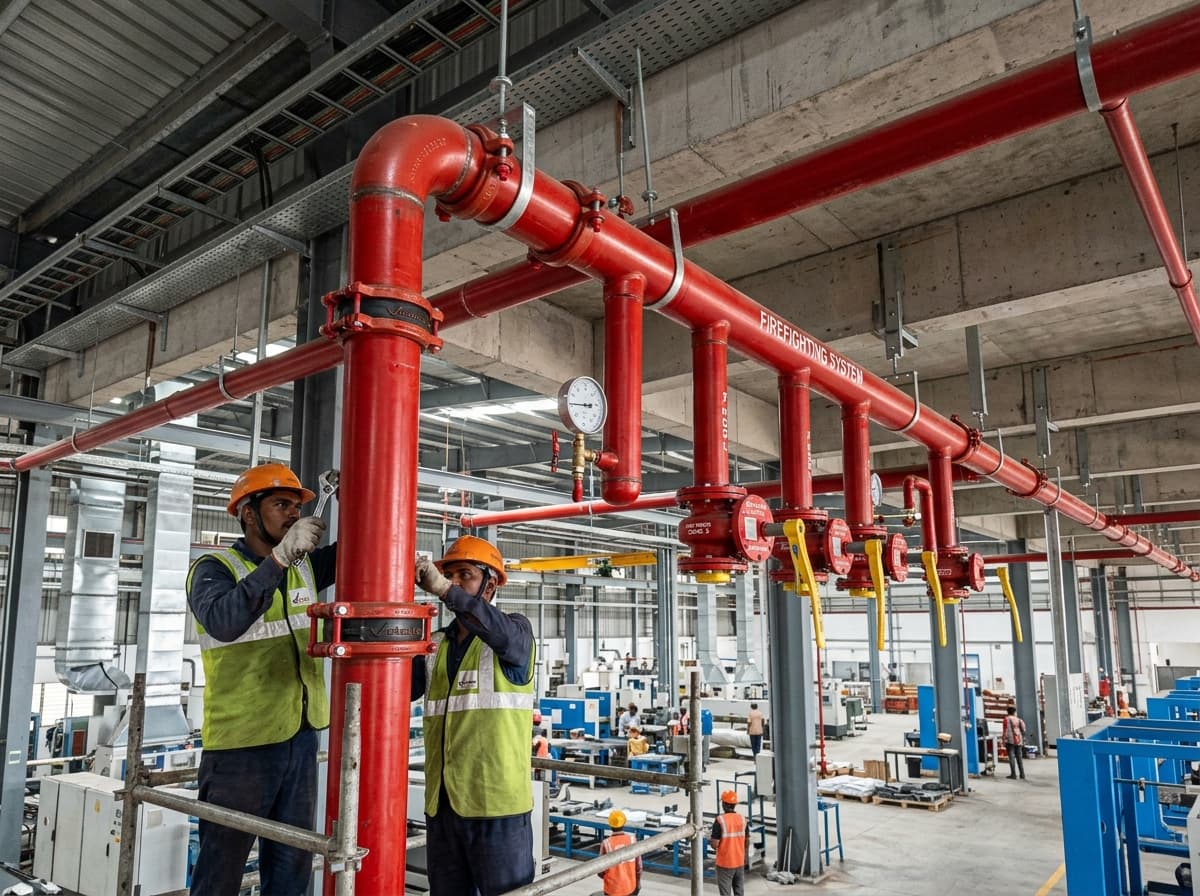
Grooved Mechanical Piping & Class C Headers
Heavy-duty ERW/Seamless MS Class C pipes (IS 1239) coupled using FM-approved grooved mechanical couplings and fittings, allowing rapid seismic-tolerant expansion and zero leakage under 16 bar test pressure.
Inspector's Test & Drain Valve Connections (ITCV)
End-of-line test connections equipped with calibrated sight glasses and orifice diameters matching the smallest installed sprinkler head, enabling routine physical flow verification without wetting floors.
Technical Parameter Matrix & Code Compliance
Calibrated against NBC 2016 Part 4 & Bureau of Indian Standards (BIS)
Hydraulic Density & Flow Parameters
Sprinkler Head & Hardware Specs
Testing & Code Compliance
Why Developers & Factory Owners in J&K Choose BSS Fire
Proper sprinkler engineering requires precise Hazen-Williams hydraulic friction loss calculations, balanced branch line sizing, and leak-proof grooved joint erection.
Computerized Hydraulic Sizing
We run certified hydraulic network calculations to determine exact pipe friction losses and pump head requirements, ensuring uniform water density at every sprinkler head.
FM-Approved Grooved Piping Fabrication
Our Jammu fitting teams use precision roll-grooving machines and FM-approved ductile iron couplings, eliminating on-site hot work in sensitive areas and accelerating erection.
24-Hour Hydrostatic Test Integrity
Every segment of our sprinkler distribution piping is hydro-tested to 15 kg/cm² for a full 24 hours in the presence of client site engineers prior to commissioning sign-off.
Seamless Single Window Fire NOC Clearance
We provide complete sprinkler layout drawings, hydraulic density curves, flow switch test logs, and alarm valve test certificates for swift J&K Fire Services NOC approval.
Step-by-Step Sprinkler Installation & Commissioning Process
A structured 6-phase engineering workflow ensuring code-compliant pipe layouts and verified hydraulic flow.
Hazard Classification & Density Sizing
We assess building occupancy, ceiling obstructions, storage rack heights, and water supply parameters, defining exact hydraulic density (LPM/m²).
- Hazard density calculation
- Water storage sizing
- Preliminary header layout
Piping Grid Schematics & BIM Coordination
We develop 2D/3D coordinated sprinkler piping layouts, branch line spacing plans, and alarm check valve station details conforming to IS 15105.
- Sprinkler layout CAD drawings
- Hydraulic calculation sheet
- MEP clash clearance
Material Mobilization & Roll-Grooving
Certified Heavy Class C MS pipes, UL-listed sprinkler heads, flow switches, and alarm check valves are delivered to site with test reports.
- Mill test certificates
- Roll-grooving inspection log
- Sprinkler head calibration tags
Mechanical Erection & Valve Station Plumbing
Our pipefitters erect main distribution headers, cross mains, branch lines, and seismic sway braces, mounting alarm valve stations on risers.
- Pipe hanger verification
- Alarm valve alignment report
- Flow switch wiring check
24-Hour Hydrostatic Testing & Flow Commissioning
The network is pressurized to 15 kg/cm² for 24 hours. We then actuate the Inspector's Test Valve (ITCV) to verify water motor gong alarm and FACP signal.
- 24-Hour Hydrostatic Test Certificate
- ITCV flow test log
- Water motor gong sign-off
Handover, Training & NOC Documentation
We train your maintenance team on alarm valve resetting, drain operation, and spare head cabinet maintenance, delivering as-built documentation.
- As-built drawings binder
- O&M user manual
- Spare head box with wrench
- NOC test certificate
Post-Commissioning Maintenance & Quarterly Flow Audits
Sprinkler networks operate under continuous static pressure. Semi-annual flow tests and valve lubrication prevent sediment accumulation and sticking.
Visual check of all sprinkler head bulbs for paint or dust obstruction; verification of alarm valve pressure gauges (system vs supply pressure); checking flow switch supervisory wiring.
Full-flow actuation test via Inspector's Test Valve (ITCV); verification of water motor gong ringing within 30 seconds; testing FACP flow switch signal and auxiliary pump cut-in.
Main drain flow test to verify absence of scale or supply pipe obstruction; lubrication of all control valve spindles; recalibration of pressure gauges and Fire NOC renewal.
Emergency Response Support: All BSS Fire sprinkler AMC clients receive priority 4-hour emergency technician dispatch across Jammu, Bari Brahmana, Samba, and Kathua for leak clearance and valve overhaul.
Explore AMC PlansRelated Industry Applications in J&K
Complementary Fire Safety Systems
Technical & Regulatory FAQs
Clear answers to common engineering, NBC compliance, and project execution questions in Jammu & Kashmir.
Does a fire activate every sprinkler head in the building simultaneously?▼
What is an ESFR (Early Suppression Fast Response) Sprinkler?▼
What happens if someone accidentally bumps or damages a sprinkler head?▼
Why is an Alarm Check Valve (ACV) necessary in a sprinkler system?▼
How often should sprinkler systems be tested under NBC 2016?▼
Need an Engineered Automatic Fire Sprinkler System in J&K?
Consult with our Jammu fire engineers for hydraulic density calculations, grooved piping design, and turnkey sprinkler commissioning across Jammu & Kashmir.